
The Palatine Chapel in Palermo: What to Know Before You Go
The Cappella Palatina is, by any serious assessment, one of the most complete and remarkable interior spaces in European art. Built between 1132 and 1143 for the Norman King Roger II, it represents the point at which three distinct traditions — Byzantine, Islamic, and Norman — operated simultaneously in a single building without apparent contradiction. The mosaics are Byzantine in technique and iconographic programme; the muqarnas ceiling is the most complex Fatimid woodcarving in existence outside of Cairo; the cosmati floor and marble columns are Norman in their classicism. That this existed at all is the first thing to understand before visiting.
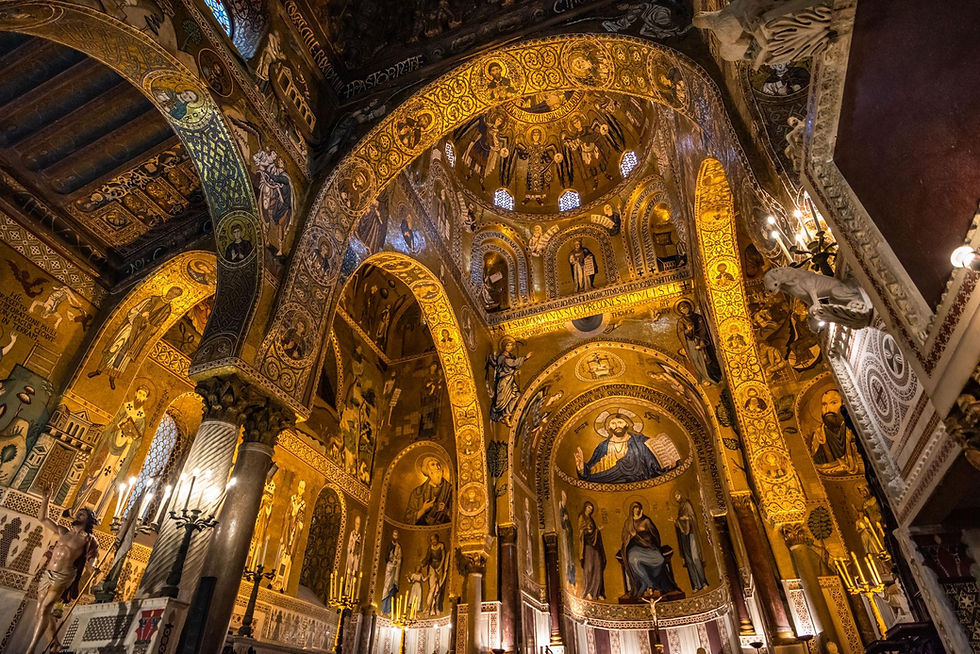
What the Palatine Chapel in Palermo Contains
The mosaics cover the nave, apse, and presbytery in a programme probably completed by Byzantine craftsmen brought from Constantinople in the 1140s. The Christ Pantocrator in the central apse — a mosaic figure of approximately four metres in height — is the dominant element. The narrative cycle around the nave walls is the most sustained reading: Stories of Saints Peter and Paul on the north wall, Stories of the Creation and of Noah on the south, Old and New Testament scenes in the presbytery. The iconographic programme is Christological and Royal simultaneously: Roger II appears in mosaic on the archway in the act of receiving his crown directly from Christ, bypassing the Pope — a statement of political theology that was controversial at the time of making and remains legible now.
The muqarnas ceiling — the carved wooden stalactite structure covering the nave — is Fatimid Islamic in style, almost certainly made by craftsmen from Cairo or from the existing Islamic population of Sicily. It depicts courtly scenes: musicians, dancers, falconers, drinking parties. Islamic-derived figurative art on the ceiling of a Christian royal chapel is not explained by the scholarship; it is accepted as evidence of the particular cosmopolitanism of Norman Sicily, where Islamic, Jewish, and Christian communities coexisted under a dynasty of French-descended rulers. The juxtaposition is not synthesis — it is coexistence, and it is unlike anything else in the history of medieval building.
How to Visit
The Cappella Palatina is accessible within the Palazzo dei Normanni on Piazza Indipendenza in Palermo. The palace is the seat of the Sicilian Regional Assembly — a functioning political institution — which introduces operational constraints on visiting. The chapel is open on a timed-entry basis, Monday to Saturday. In high season, queuing outside the palace gates begins an hour before opening. The standard public visit allows approximately forty-five minutes inside — not enough. The ceiling alone requires an hour of concentrated attention. A private arrangement, coordinated through established relationships with the Fondazione Federico II that manages the palace, allows for extended access and a specialist art historian who can explain both the mosaic iconographic programme and the structural logic of the muqarnas. This is not a convenience; it is the difference between seeing the chapel and understanding it.
The Arab-Norman Route Beyond the Chapel
The Palatine Chapel is the highest point of the Arab-Norman UNESCO route in Palermo but not the only one. San Giovanni degli Eremiti (1136) — the five red domes visible over the city's roofline — is five minutes' walk from the palace. La Martorana (1143), with its Norman-era Byzantine mosaics intact on the interior walls, is in the centre of the historic city on the Via Vittorio Emanuele. San Cataldo (1154–1160) is directly adjacent. The full Arab-Norman route, which includes the cathedrals at Cefalù and Monreale in addition to the Palermo buildings, represents a coherent artistic and political programme that is more legible as a whole than as individual sites visited in isolation.


