
Sardinia in Spring: Wildflowers, Empty Coves and the Island Before the Season
Updated: Apr 1
The Sardinian summer — July and August specifically — is a functioning miracle of logistics: four million visitors crowding an island of one and a half million residents, every beach a negotiated space, every restaurant booked four weeks ahead. The infrastructure performs. The experience, for anyone who has not prearranged every element, is competitive in a way that the island itself is not. Sardinia before the season is a different proposition entirely, and April and May are the months that demonstrate what it is before the season turns it into something else.
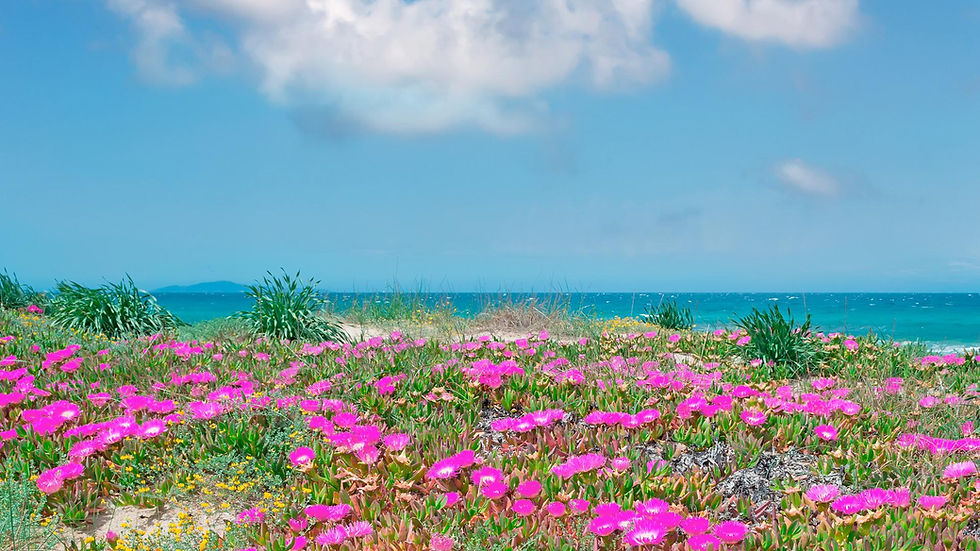
Sardinia in Spring - The Island in Bloom
Sardinia's spring botanical moment is one of the most varied in the Mediterranean basin. The island's isolation — separated from the continental landmass since the Miocene — has produced an unusually high rate of endemic species: over two hundred plants found nowhere else on earth. In April, the macchia — the dense scrubland of lentisk, myrtle, cistus, rosemary, and rockrose — is in full flower across the coastal strips and the low hills. The cistus produces white and pink flowers that fall and regenerate daily. The broom covers hillsides in yellow. The wild orchids of the Sarcidano plateau — some twenty endemic species — bloom in April and May across the limestone grasslands east of Oristano.
The Sea in Spring
The sea temperature in April averages 15–17°C — cold for swimming in the manner of July, but entirely reasonable for those accustomed to the Atlantic or northern European seas. The Costa Verde in the southwest — enormous sand dunes, sea-carved rock formations, the post-industrial archaeology of the Montevecchio mining district directly behind the shore — is accessible in April without the organisational difficulty of summer. The beaches of the Gulf of Asinara in the northwest, the coves of the Sulcis peninsula in the south, the coastal platforms of the Ogliastra in the east: all are functioning elements of the island's landscape in spring, and none are occupied.
The Interior in Spring
Sardinia's interior — the Barbagia, the Gennargentu massif, the Supramonte limestone plateau above Orgosolo — is the part of the island that most visitors do not reach in any season. In April, the Gennargentu is still snow-capped above 1,500 metres, the valleys below full of grazing sheep and the shepherd economy that has organised this landscape for three thousand years. The nuragic settlements — the pre-Roman Bronze Age tower complexes that cover the island in their thousands — are visible in spring grass and wildflower cover in a way that summer-baked earth does not reproduce.
The inland Barbagia towns: Orgosolo, with its murales; Oliena, at the base of the Supramonte, producing the Nepente di Oliena that D.H. Lawrence wrote about; Fonni, the highest town in Sardinia — are operating in their normal register in April, without any visible tourist economy overlaid on their daily life. The Epicureo approach to Sardinia in spring is structured around private access to sheep-farming estates of the Barbagia, the shepherd cooperatives producing Pecorino Sardo DOP from the spring milk, and private visits to major nuragic complexes outside public visiting hours.


