
Matera in Winter: The City Without Its Crowds
Updated: Apr 1
Matera is one of the few places in southern Italy where the question of when to visit changes not merely the comfort of the experience but its essential character. The Sassi — the ancient cave dwellings carved into the two ravines of the Gravina — read differently in different seasons, and the reading in January is the one that most people who visit Matera in summer have not encountered. The winter city is, in most respects, the more complete argument for going.
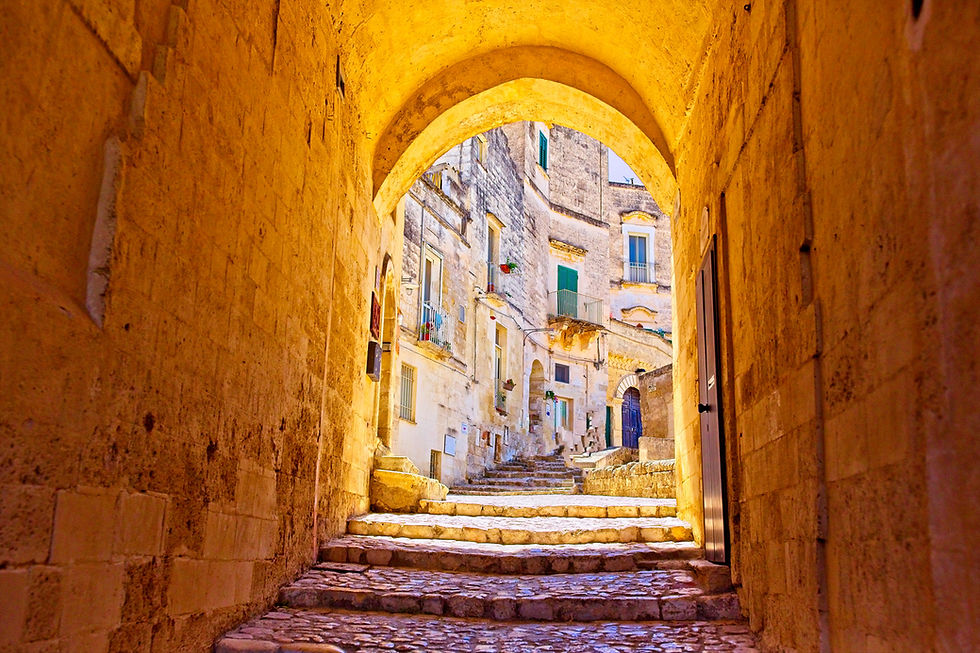
The Architecture in Winter Light
The Sassi are made of tufa, a sedimentary limestone quarried from the Gravina ravine itself and used both as the medium of excavation and as building material for the facades that front the cave interiors. Tufa is pale gold when dry, darker gold when wet, and its response to low winter light — entering horizontally in January rather than vertically in July — is architecturally revealing in a way that summer light, which bleaches everything into a uniform white, is not. The stratification of the Sasso Caveoso, the terraced logic of houses and churches built into and over one another across five thousand years of continuous habitation, becomes readable in winter in a way that high-sun visits rarely allow.
The light window between 9:00 and 11:00 in January produces the most architecturally significant conditions of the year. The city is quiet. The tour groups that fill the main paths in summer are absent. The calcarenite facades reflect the morning light without competing with other visitors for attention.
The Sassi Beyond the Tourist Circuit
The standard Matera visit covers the Sasso Barisano from Piazza Vittorio Veneto, the main viewpoint from the Murgia Plateau, and perhaps the Cripta del Peccato Originale with its eighth-century Byzantine frescoes. This is a reasonable introduction, but it leaves the more particular parts of the Sassi unvisited: the minor rupestrian churches, the cave cistern networks, the private hypogea opened for visit only in the past fifteen years. In winter, with a private guide who knows the access arrangements for the non-ticketed spaces, the city that exists below and beyond the tourist surface becomes accessible.
The Palombaro Lungo — the vast cistern beneath Piazza Vittorio Veneto that held the city's water supply until the 1950s — is rarely included in standard visits. The cave church of San Pietro Barisano, the largest rupestrian church in Matera, with a complex carved interior of three naves and altars, is more architecturally complete than many of the better-known churches. The private cave dwellings converted for visit, showing the conditions in which twenty thousand people lived underground until the forced evacuations ordered by Alcide De Gasperi after Carlo Levi's Cristo si è Fermato a Eboli, are comprehensible in a January afternoon without a queue.
Matera in winter, the City After Dark
Matera in winter evenings has a quality that summer does not replicate. The Sassi are lit by low warm lighting after dark, and the ravine is largely silent. The restaurants that remain open in January are the ones with the strongest argument for continued operation: the cucina lucana, the Basilicata cuisine of legumes, lamb, and the peperone crusco. The caciocavallo podolico. The orecchiette with turnip greens that arrived from Puglia but found its most rugged expression in the inland towns. January in Matera is, among other things, the best time to eat there.


